
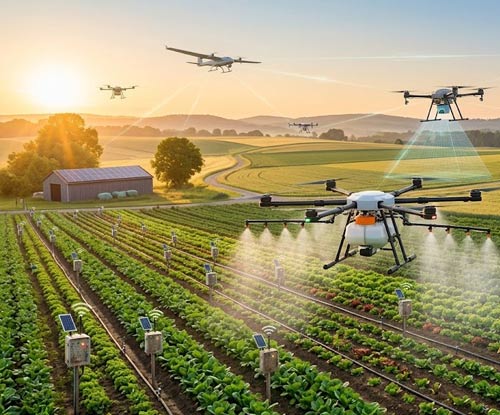
Agriculture has always been one of the most important industries in human history, but modern farming faces many challenges, including climate change, labor shortages, increasing production costs, and growing food demand. To overcome these challenges, farmers are increasingly adopting advanced technologies that improve efficiency and productivity. Among these innovations, agricultural drones have become one of the most powerful tools for modern farming.
Drones, also known as unmanned aerial vehicles (UAVs), are changing the way farmers monitor crops, manage resources, and make decisions. Equipped with high-resolution cameras, sensors, GPS systems, and artificial intelligence capabilities, drones provide farmers with valuable insights about field conditions that were previously difficult or impossible to obtain.
By enabling accurate monitoring and faster analysis, drones are becoming an essential part of precision agriculture and smart farming systems.
Understanding Agricultural Drones
Agricultural drones are specialized flying devices designed to collect data and perform various farming operations. Unlike traditional methods that require farmers to manually inspect large areas of land, drones can quickly capture detailed information from above.
Modern farming drones can be equipped with different technologies, including:
- RGB cameras for standard aerial photography
- Multispectral sensors for plant health analysis
- Thermal cameras for detecting temperature variations
- LiDAR sensors for mapping and terrain analysis
- GPS systems for accurate navigation
These technologies allow farmers to analyze crop conditions, identify problems, and optimize agricultural activities.
Crop Monitoring and Field Analysis
One of the most common applications of drones in agriculture is crop monitoring. Traditionally, farmers needed to walk through fields to check crop conditions manually. This approach was time-consuming and often failed to detect early problems.
Drones provide a faster and more accurate alternative. By flying over agricultural fields, drones capture detailed images that reveal important information about plant health.
Farmers can identify:
- Areas with poor crop growth
- Signs of nutrient deficiencies
- Water stress
- Pest infestations
- Disease development
Early detection allows farmers to respond quickly and prevent major crop losses.
The Role of Drones in Precision Agriculture
Precision agriculture focuses on using technology to manage crops more efficiently by applying resources only where they are needed. Drones play a critical role in this approach by providing accurate field data.
For example, instead of applying fertilizers uniformly across an entire farm, drone-generated maps can identify areas with different nutrient requirements. Farmers can then apply fertilizer only to specific locations, reducing waste and improving crop performance.
Similarly, drone data can help optimize irrigation strategies by identifying areas that require more or less water.
This targeted approach reduces costs, improves sustainability, and increases agricultural productivity.
Drone-Based Crop Spraying
Beyond monitoring, drones are also used for agricultural spraying. Drone sprayers can apply pesticides, fertilizers, and biological treatments with high precision.
Compared with traditional spraying equipment, agricultural drones offer several advantages:
- They can access difficult terrain
- They reduce chemical waste
- They minimize soil damage
- They operate faster in certain conditions
- They reduce human exposure to chemicals
Drone spraying systems can adjust application rates based on field conditions, ensuring that crops receive the appropriate treatment.
Artificial Intelligence and Drone Technology
Artificial intelligence has significantly enhanced the capabilities of agricultural drones. AI-powered systems can analyze drone images and identify patterns that may not be visible to the human eye.
Machine learning algorithms can detect plant diseases, classify crop conditions, and predict potential problems before they become serious.
For example, AI systems can compare current drone images with historical data to determine whether crops are developing normally. If abnormal patterns appear, farmers receive alerts and recommendations.
The combination of drones and AI creates a powerful decision-support system that helps farmers manage their operations more effectively.
Benefits of Using Drones in Agriculture
Increased Efficiency
Drones can survey large agricultural areas in a short period of time. This saves farmers significant time compared with traditional field inspections.
Improved Crop Yields
By identifying problems early and optimizing resource usage, drones help farmers improve crop health and increase production.
Reduced Costs
Accurate data allows farmers to avoid unnecessary applications of water, fertilizers, and pesticides. This reduces operational expenses.
Better Decision-Making
Drones provide real-time information that supports data-driven farming decisions rather than relying only on experience or assumptions.
Environmental Protection
By reducing chemical usage and improving resource efficiency, drones contribute to more sustainable agricultural practices.
Challenges of Agricultural Drone Adoption
Despite their advantages, agricultural drones also face several challenges. One major limitation is the cost of purchasing advanced drone systems and specialized sensors.
Small-scale farmers may find it difficult to invest in expensive equipment. Additionally, operating agricultural drones requires technical knowledge and proper training.
Regulations regarding drone flights can also create challenges. Many countries have specific rules related to airspace usage, safety requirements, and data management.
Battery limitations and weather conditions may also affect drone performance in certain environments.
The Future of Drones in Farming
The future of agricultural drones is closely connected with artificial intelligence, automation, and robotics. Future drones will become more autonomous and capable of performing complex agricultural tasks with minimal human involvement.
Advanced drone systems may combine satellite data, AI analytics, and robotic technologies to create fully automated farming solutions.
Swarm drone technology could allow multiple drones to work together, monitoring and managing large farms more efficiently.
As agriculture continues to evolve, drones will become an increasingly important tool for creating smarter, more sustainable, and more productive farming systems.
Conclusion
Drones are transforming modern agriculture by providing farmers with accurate data, improving resource management, and enabling faster decision-making. From crop monitoring and disease detection to precision spraying and AI-powered analysis, drones offer numerous benefits for the future of farming.
As technology continues to advance, agricultural drones will play a central role in the development of smart farming and sustainable food production. Their ability to combine efficiency, accuracy, and innovation makes them one of the most valuable technologies shaping the future of agriculture.


No comment